Investigation & Analysis of 1000 Indoor Environments in the UK. A presentation to Public Health UK (2018) by Safe Air Quality’s Roger Martin BSc(Hons) MIAQM MIAQA
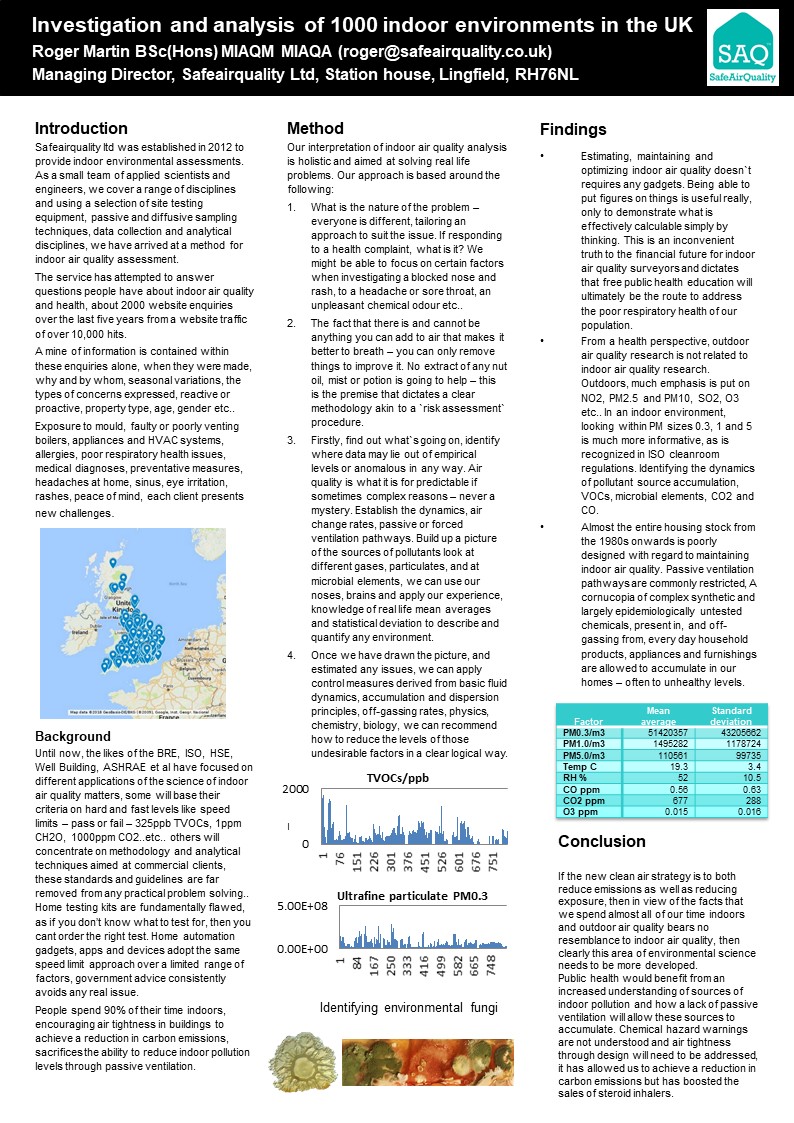
Investigation and Analysis of 1000 Indoor Environments in the UK
Roger Martin BSc(Hons) MIAQM MIAQA (roger@safeairquality.co.uk) Managing Director, Safeairquality Ltd, Station house, Lingfield, RH76NL
Introduction
Safeairquality Ltd, established in 2012, specializes in indoor environmental assessments. Our team of applied scientists and engineers employs a diverse range of disciplines, utilizing various site testing equipment, passive and diffusive sampling techniques, and robust data collection and analytical methods to assess indoor air quality.
Over the past five years, our service has addressed approximately 2,000 website inquiries concerning indoor air quality and its impact on health. This extensive data provides a wealth of information regarding the origin, timing, and reasons for concerns, including seasonal variations, types of issues (reactive or proactive), and factors such as property type, age, and gender.
Common challenges reported by clients include exposure to mold, issues with faulty or poorly venting boilers, appliances, and HVAC systems, allergies, respiratory health problems, medical diagnoses, and symptoms such as headaches, sinus issues, eye irritation, rashes, and a general lack of peace of mind.
Background
Historically, organizations like BRE, ISO, HSE, Well Building, and ASHRAE have focused on various applications of indoor air quality science. Some base their criteria on strict pass/fail limits for substances like TVOCs (325 ppb), CH2O (1 ppm), and CO2 (1000 ppm). Others prioritize methodologies and analytical techniques for commercial clients. These standards and guidelines often fall short of practical problem-solving.
Home testing kits are inherently flawed; without knowing what to test for, one cannot select the appropriate test. Similarly, home automation gadgets, apps, and devices often adopt a speed limit approach that overlooks a broader range of factors, and government advice frequently fails to address real issues.
Despite spending 90% of their time indoors, people often encourage airtightness in buildings to reduce carbon emissions, inadvertently sacrificing the ability to lower indoor pollution levels through passive ventilation.
Method
Our approach to indoor air quality analysis is holistic, focusing on solving real-life problems. The methodology is structured as follows:
1.Nature of the Problem: Every individual is unique, requiring a tailored approach. When addressing a health complaint, such as a blocked nose, rash, headache, sore throat, or an unpleasant chemical odor, we identify specific contributing factors.
2.The Principle of Removal: It is impossible to add anything to the air to improve its quality; only by removing harmful elements can it be made better. This premise underpins our clear methodology, which is akin to a ‘risk assessment’ procedure.
3.Data Identification and Analysis: We first determine the current situation and identify where empirical levels or anomalies may exist. Air quality, though sometimes complex, is predictable. We establish the dynamics, air change rates, and passive or forced ventilation pathways. By examining different gases, particulates, and microbial elements, and applying our experience, knowledge of real-life mean averages, and statistical deviation, we describe and quantify the environment.
4.Control Measures: Once the situation is understood and issues are identified, we apply control measures based on fluid dynamics, accumulation and dispersion principles, off-gassing rates, physics, chemistry, and biology. Our recommendations aim to reduce undesirable factors in a clear and logical manner.
Findings
Estimating, maintaining, and optimizing indoor air quality does not necessitate expensive gadgets. The ability to quantify these factors is valuable, primarily because it demonstrates what is effectively calculable through logical thought. This reality poses a challenge to the financial future of indoor air quality surveyors and underscores that free public health education is the ultimate path to improving the respiratory health of the population.
From a health perspective, outdoor air quality research is often unrelated to indoor air quality research. While significant emphasis is placed on outdoor pollutants like NO2, PM2.5, PM10, SO2, and O3, indoor environments provide more informative data when examining PM sizes 0.3, 1, and 5, as recognized by ISO cleanroom regulations. This includes identifying the dynamics of pollutant source accumulation, VOCs, microbial elements, CO2, and CO.
Most housing stock built from the 1960s onwards is poorly designed for maintaining good indoor air quality, with passive ventilation pathways often restricted. A vast array of complex synthetic and largely epidemiologically untested chemicals, present in and off-gassing from everyday household products, appliances, and furnishings, are allowed to accumulate in homes, frequently leading to unhealthy levels.
Conclusion
If the new clean air strategy aims to reduce both emissions and exposure, it must acknowledge that people spend almost all their time indoors, and indoor air quality bears no resemblance to outdoor air quality. Therefore, this area of environmental science requires significant development. Public health would greatly benefit from an increased understanding of indoor pollution sources and how a lack of passive ventilation contributes to their accumulation. Chemical hazard warnings are often misunderstood, and air tightness, which needs to be addressed through design, has inadvertently boosted the sales of steroid inhalers.